Fake Crypto Websites: How Beginners Can Spot Danger Before Connecting a Wallet
The moment you connect your crypto wallet to a website, you are opening a door. If that website is fake, what walks through that door can empty your wallet in seconds. This is not a rare edge case. It happens to beginners and experienced users alike, every single day.
Fake crypto websites are one of the most common threats in the space right now. They are built to look legitimate, feel professional, and create just enough urgency to make you act before you think. Understanding how they work is the first step to staying safe.
Why Fake Crypto Websites Are So Effective
Most people assume scam websites look obviously suspicious. In reality, the most dangerous ones are nearly indistinguishable from the real thing. Scammers invest real effort into copying logos, color schemes, layouts, and even the language used by legitimate platforms.
The goal is simple: get you to connect your wallet or enter your seed phrase before you realize something is wrong. Once either of those things happens, the damage is usually irreversible. Blockchain transactions cannot be undone.
This is why learning to pause and check before you click is one of the most valuable habits you can build as someone new to crypto.
The Domain Name Is Always the First Clue
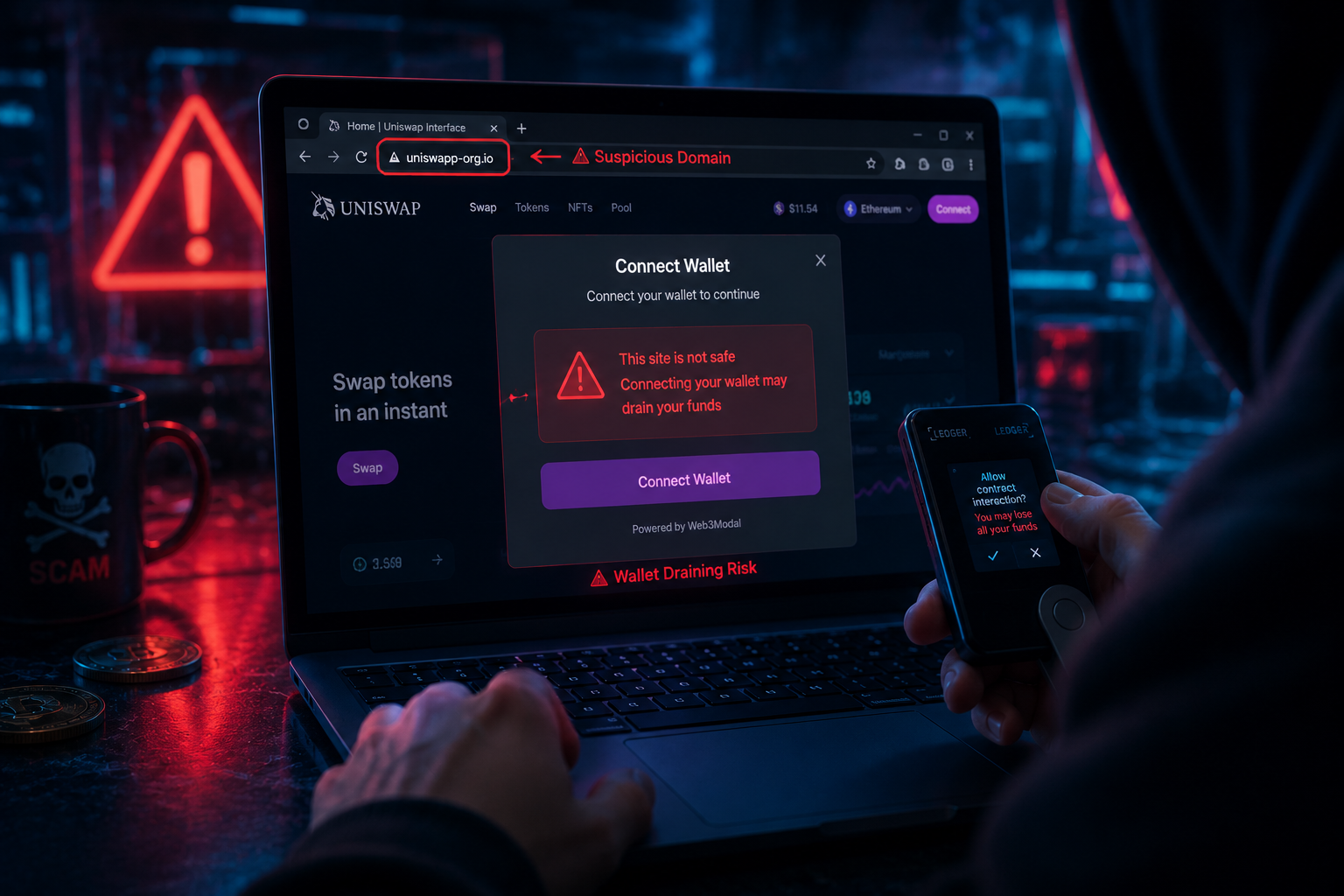
Every fake website has to live somewhere on the internet, and that means it needs a domain name. Scammers cannot use the exact domain of the platform they are imitating, so they get creative with small changes that are easy to miss at a glance.
You might see a legitimate exchange name with a different ending, such as dot-net instead of dot-com. Or a single letter changed, like replacing an lowercase L with the number 1. Sometimes a word is added, such as the platform name followed by the word official, support, or airdrop.
Always look at the full URL in your browser bar before doing anything on a site. Type the address manually when possible rather than clicking a link from social media, email, or a messaging app. A few extra seconds spent checking the domain can prevent a serious loss.
Cloned Landing Pages and What They Hide
A cloned landing page is a copy of a real website built for the sole purpose of deception. These pages can replicate a genuine platform almost perfectly, including the visual design, the navigation menu, and even some functional elements.
What they cannot replicate is the backend. When you interact with a cloned page, your inputs go somewhere else entirely. If you enter your seed phrase thinking you are recovering a wallet, that phrase is sent directly to the scammer. If you connect your wallet and approve a transaction, you may be signing away access to your funds.
One practical check is to look for small inconsistencies. Cloned pages often have broken links, slightly misaligned elements, placeholder text, or pages that lead nowhere. If something feels slightly off visually, trust that instinct and investigate before proceeding.
Countdown Timers and Artificial Urgency
One of the most reliable psychological tools used by fake crypto websites is the countdown timer. You land on a page and see a clock ticking down, telling you that an exclusive airdrop, a limited token sale, or a special reward is about to expire.
This urgency is manufactured. It exists to prevent you from thinking clearly or taking time to verify what you are looking at. Legitimate platforms do run time-limited events, but they do not pressure you to connect a wallet within minutes of arriving on a page with no prior context.
If you feel rushed, that is a signal to slow down. Genuine opportunities in crypto do not disappear because you took ten minutes to verify a website. Scams, however, depend on you not taking those ten minutes.
Wallet Connect Traps and What Approval Really Means
Connecting a wallet to a website is not the same as giving someone your password, but it is not without risk either. When a site asks you to connect your wallet and then prompts you to approve a transaction or sign a message, you need to read exactly what you are approving.
Some fake websites use wallet connection requests that, once approved, grant the site permission to move tokens from your wallet without any further confirmation from you. This is called a malicious approval, and it is a common mechanism behind wallet draining attacks.
Before approving any transaction, read the details shown in your wallet interface carefully. If the language is vague, if the permissions seem broader than what the site should need, or if you do not fully understand what you are signing, do not approve it. Closing the window and walking away is always a valid choice.
Fake Support Accounts and Social Engineering
Fake crypto websites rarely operate alone. They are often supported by networks of fake social media accounts, fake customer support agents, and fake community members who direct confused users toward the dangerous site.
If you post a question in a public forum or comment section about a crypto platform, you may receive direct messages from accounts claiming to be official support. These accounts often have convincing profile pictures, follower counts, and professional language. They will offer to help you and eventually ask you to visit a link or share your recovery phrase.
No legitimate crypto platform will ever ask for your seed phrase. Not in a support chat, not in an email, not anywhere. This is an absolute rule with no exceptions.
Practical Checks Before You Click or Connect
Building a short personal checklist before interacting with any crypto website is one of the most effective protective habits you can develop.
First, verify the domain name character by character against the official source. Find the official website through the project's verified social media profiles or a trusted aggregator, not through a search engine ad.
Second, check whether the site has a valid security certificate. Look for the padlock icon in your browser bar. While this alone does not guarantee a site is safe, its absence is a clear warning sign.
Third, search for the platform name alongside words like scam or fake to see if others have reported problems. Community forums and review platforms often surface warnings quickly.
Fourth, if you are using a hardware wallet, always read the transaction details on the device screen itself, not just on the website.
Fifth, consider using a separate browser wallet with a small amount of funds for exploring new platforms, keeping your main holdings in a more secure setup.
Beginner Safety Note
If you are new to crypto, the single most important thing you can protect is your seed phrase. This is the sequence of words given to you when you first set up a wallet. It is the master key to everything in that wallet. Write it down on paper, store it somewhere physically secure, and never type it into any website or app under any circumstances. No real platform will ever need it.
Common Mistakes to Avoid
Clicking links from unsolicited direct messages, even from accounts that appear to be official, is one of the most frequent ways people land on fake sites. Avoid this entirely.
Using search engine results without checking the URL is another common error. Paid advertisements in search results have been used to promote fake crypto websites that appear above the legitimate platform.
Approving wallet transactions without reading them carefully is a mistake that can have immediate consequences. Take the time to understand what each approval does before confirming.
Assuming that a professional-looking website is trustworthy is a mindset that scammers actively exploit. Design quality is no longer a reliable indicator of legitimacy.
A Balanced Conclusion
The crypto space offers genuine opportunities to learn about a new kind of financial infrastructure, but it also attracts people who want to exploit those who are still learning. Fake crypto websites are a real and persistent threat, and they are designed specifically to catch people who are moving quickly or acting on excitement.
The good news is that most of these threats can be avoided with a small amount of careful attention. Checking domain names, reading wallet prompts, ignoring artificial urgency, and protecting your seed phrase are habits that cost nothing but a few moments of your time. In crypto, those moments matter enormously.
Stay curious, stay cautious, and verify before you connect.